INTRODUCTION
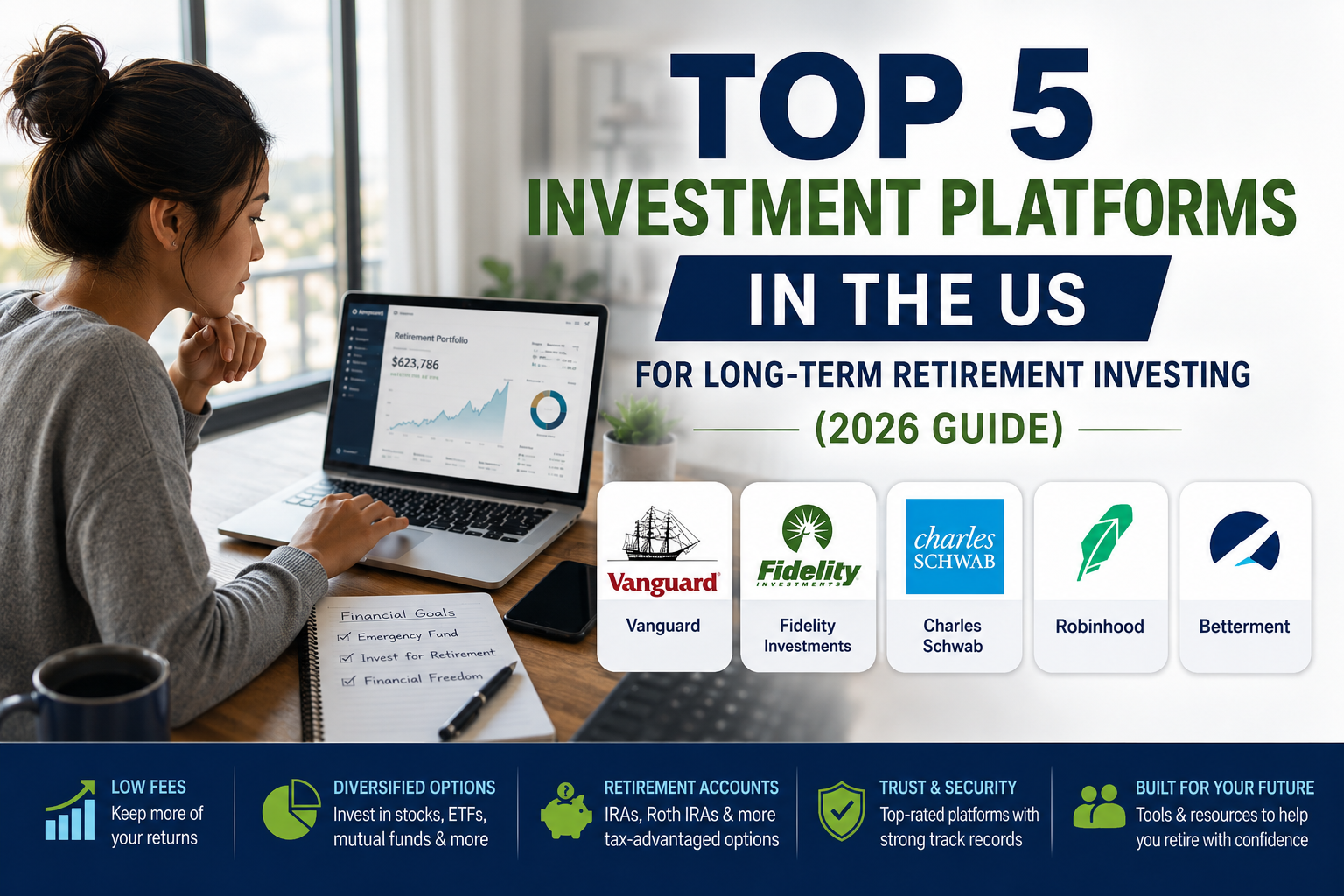
Choosing the right investment platform can feel overwhelming, especially with so many options available today. Whether you’re just starting with your first $100 or managing a growing retirement portfolio, the platform you choose plays a major role in your long-term financial success. Some platforms are built for long-term retirement investing, while others cater to active traders or complete beginners. The wrong choice could mean higher fees, limited investment options, or missing out on features that help your money grow. After comparing costs, retirement tools, investment variety, and overall reputation, here are the five best investment platforms in the United States for 2026.
A few years ago, investing felt like something only financial advisors or Wall Street professionals did. Today, that’s completely changed. Whether you’re putting away your first $100 or building a six-figure retirement portfolio, there are investment platforms designed to make the process simple, affordable, and surprisingly accessible.
But here’s the catch: not every investment platform is built the same.
Some are perfect for long-term retirement investing, while others focus more on active trading or beginner-friendly investing. Choosing the wrong platform could mean paying higher fees, having fewer investment options, or missing out on features that could help your money grow over time.
That’s exactly why I put together this guide.
After comparing costs, retirement features, investment choices, ease of use, customer support, and overall reputation, these are the five best investment platforms in the United States for 2026.
Quick Comparison
| Platform | Best For | Minimum Investment | Trading Fees | Retirement Accounts |
|---|---|---|---|---|
| Vanguard | Long-term retirement investors | $0 (many accounts) | $0 for online US stocks & ETFs | Yes |
| Fidelity Investments | Overall investing | $0 | $0 | Yes |
| Charles Schwab | Research & retirement planning | $0 | $0 | Yes |
| Robinhood | Beginners & mobile investing | $0 | $0 | Limited retirement options |
| Betterment | Hands-off automated investing | $10 to start (or $0 with recurring deposits, depending on account) | Annual advisory fee | Yes |
Note: Fees, account minimums, and features may change over time. Always check each provider’s official website before opening an account.
What Makes a Great Retirement Investment Platform?
When your goal is retirement—not quick profits—you should evaluate a platform differently.
Here are the factors that actually matter.
Low Fees
Every dollar paid in fees is a dollar that can’t compound over the next 20 or 30 years. Even small annual costs can significantly reduce your portfolio over time.
Diversified Investment Options
The best retirement investors don’t rely on a single stock. They build diversified portfolios using index funds, ETFs, mutual funds, bonds, and other assets.
Tax-Advantaged Retirement Accounts
Platforms that offer Traditional IRAs, Roth IRAs, SEP IRAs, and other retirement accounts make it easier to invest while taking advantage of potential tax benefits.
Strong Reputation
When you’re trusting a company with your retirement savings, stability matters. The largest investment firms have decades of experience and manage trillions of dollars in client assets. TOP 5 INVESTMENT PLATFORM
1. Vanguard — Best Overall for Long-Term Retirement Investing

Official Website: https://investor.vanguard.com
“Vanguard is one of the most trusted investment platforms for anyone who wants to build wealth steadily over the next 20–30 years.”
Vanguard has built its reputation around one simple philosophy: keep investing costs low and let compound growth do the heavy lifting.
Instead of encouraging constant buying and selling, Vanguard focuses on disciplined, long-term investing. That’s exactly what retirement planning is all about.
Why People Love Vanguard
One of Vanguard’s biggest strengths is its collection of low-cost index funds.
Rather than trying to beat the market every year, many investors simply buy broad-market funds that track indexes like the S&P 500 or the total U.S. stock market. Historically, this approach has helped many long-term investors build wealth while keeping fees relatively low.
Another reason Vanguard stands out is trust.
The company has spent decades building a reputation for putting investors first instead of encouraging excessive trading.
Pros
- Extremely low expense ratios
- Excellent retirement planning tools
- Large selection of index funds
- Trusted by millions of investors
- Ideal for long-term investing
Cons
- Website can feel basic compared to newer apps
- Not designed for active day traders
Fees
- Stock Trades: $0 online for eligible U.S. stocks and ETFs
- Many account minimums: $0
- Expense ratios vary by fund
Example Investment (Illustrative Only)
Imagine investing $500 every month into a diversified portfolio earning an average 7% annual return over the long term.
After 30 years, your contributions would total about $180,000, while the portfolio could grow to roughly $600,000. This example illustrates the power of compounding and is not a guarantee of future performance.
2. Fidelity Investments — Best All-Around Investment Platform
Official Website: https://www.fidelity.com
If Vanguard is the steady marathon runner, Fidelity is the versatile all-rounder.
“As one of the most versatile investment platforms available, Fidelity offers nearly everything an investor could want.”
Whether you’re just starting or already managing a sizable retirement portfolio, Fidelity has the tools to grow with you.
What Makes Fidelity Different?
One feature I genuinely appreciate is how beginner-friendly it feels without sacrificing professional-grade tools.
New investors can learn at their own pace, while experienced investors have access to advanced research, screeners, and detailed market insights.
Fidelity also offers several index funds with very low costs, making it easier to build a diversified retirement portfolio.
Pros
- $0 commission on many online U.S. stock and ETF trades
- Excellent customer service
- Outstanding research tools
- Great mobile app
- Wide variety of retirement accounts
Cons
- Some advanced features may feel overwhelming at first
- Certain managed services have additional fees
Fees
- Stock Trades: $0 online for eligible U.S. stocks and ETFs
- Account Minimum: $0 for many accounts
- Mutual fund fees depend on the specific fund
Example Investment (Illustrative Only)
Suppose you invest $10,000 today and then add $300 every month for the next 25 years, earning an average annual return of 7%.
Your total contributions would be $100,000, and your portfolio could grow to approximately $250,000–$270,000, depending on the exact timing of contributions and market performance. Again, this is an illustration—not a promise.
Which Platform Is Better So Far?
After comparing the first two, here’s my quick take.
Choose Vanguard if your primary goal is building long-term retirement wealth with low-cost index funds and a “set it and forget it” approach.
Choose Fidelity if you want a broader range of tools, more educational content, and flexibility as your investing experience grows.
Both are excellent choices, and neither requires you to be a financial expert to get started

3. Charles Schwab — Best for Research and Retirement Planning
Official Website: https://www.schwab.com
If you’re someone who likes doing a bit of homework before investing, Charles Schwab is hard to beat.
Schwab has been around for decades and has built a strong reputation for combining professional-grade research with beginner-friendly tools. Whether you’re investing in ETFs, mutual funds, stocks, bonds, or retirement accounts, the platform gives you plenty of flexibility.
One thing that really stands out is the amount of educational content available. Instead of simply letting you buy investments, Schwab helps you understand why you’re investing in them.
“This makes Schwab one of the most research-friendly investment platforms on this list.”
Why Choose Charles Schwab?
Schwab is especially appealing to investors who want to manage their retirement savings themselves while still having access to professional guidance if needed.
Its retirement planning calculators, portfolio analysis tools, and investment screeners make it easier to build a strategy that fits your goals.
Pros
- Excellent investment research
- Wide range of retirement accounts
- Strong customer support
- $0 online commissions on eligible U.S. stocks and ETFs
- Great educational resources
Cons
- Interface may feel overwhelming for complete beginners
- Some advanced investment products have additional costs
Fees
- Minimum investment for many brokerage accounts: $0
- Online U.S. stock and ETF trades: $0
- Mutual fund and advisory fees vary depending on the investment selected
Example Investment (Illustrative Only)
If you invest $20,000 today and contribute $500 per month for 20 years, assuming an average annual return of 7%, your portfolio could grow to roughly $420,000–$470,000. Actual investment returns will vary, and future performance is never guaranteed.
4. Robinhood — Best for Beginners and Mobile Investing
Official Website: https://robinhood.com
“Robinhood remains one of the simplest investment platforms for people who’ve never invested before.”
If you’ve never invested before and the idea of traditional brokerage platforms feels intimidating, Robinhood offers one of the easiest experiences available.
The app is clean, quick, and designed for people who want to start investing without spending hours learning complicated software.
That said, simplicity comes with trade-offs.
Robinhood isn’t as comprehensive for retirement planning as some of the more established firms. While it has expanded its retirement offerings in recent years, investors looking for advanced planning tools may eventually outgrow it.
Why Beginners Like Robinhood
The platform removes many of the barriers that kept younger investors away from the stock market.
Fractional shares also make it possible to invest with small amounts of money, allowing new investors to build diversified portfolios without needing thousands of dollars upfront.
Pros
- Beginner-friendly interface
- Fractional share investing
- $0 commission on eligible trades
- Fast account setup
- Excellent mobile experience
Cons
- Fewer retirement planning resources
- Limited research tools compared with larger brokerages
Fees
- Minimum investment: $0
- Online stock and ETF trades: $0
- Optional premium subscription available for additional features
Example Investment (Illustrative Only)
Someone investing $100 every month for 30 years with an assumed average annual return of 7% could contribute $36,000 and potentially accumulate around $120,000. This example is for educational purposes only and is not a prediction.

5. Betterment — Best for Hands-Off Investing
Official Website: https://www.betterment.com
“For hands-off investors, Betterment is one of the best investment platforms for automated portfolio management.”
That’s exactly where Betterment shines.
Betterment is a robo-advisor, meaning it builds and manages a diversified investment portfolio based on your goals, time horizon, and risk tolerance.
Instead of asking you to pick individual investments, it handles the day-to-day management automatically.
For busy professionals or anyone who prefers a “set it and forget it” strategy, this can be a huge advantage.
Why Betterment Stands Out
Betterment automatically rebalances your portfolio and offers features like tax-loss harvesting on eligible accounts, helping investors maintain their target allocation and potentially improve tax efficiency.
The experience feels less like active investing and more like having a digital financial coach quietly working in the background.
Pros
- Automated portfolio management
- Easy retirement planning
- Goal-based investing
- Automatic rebalancing
- User-friendly interface
Cons
- Advisory fee applies
- Less flexibility for investors who want to choose individual stocks
Fees
- Typical digital plan advisory fee: 0.25% annually (subject to change)
- Minimum investment requirements depend on the account type and funding method
Example Investment (Illustrative Only)
Investing $300 per month for 25 years with an assumed average annual return of 7% could grow to approximately $240,000, while total contributions would be $90,000. Actual returns will differ depending on market performance.
Comparison of the Top Five Investment Platforms
| Platform | Best For | Minimum Investment | Advisory Fee | Retirement Accounts | Overall Rating |
|---|---|---|---|---|---|
| Vanguard | Long-term retirement investing | $0 (many accounts) | Varies by fund/service | ✔ | ⭐⭐⭐⭐⭐ |
| Fidelity Investments | Overall investing | $0 | Varies | ✔ | ⭐⭐⭐⭐⭐ |
| Charles Schwab | Research & retirement planning | $0 | Varies | ✔ | ⭐⭐⭐⭐☆ |
| Robinhood | Beginners | $0 | None for self-directed investing | Limited | ⭐⭐⭐⭐☆ |
| Betterment | Automated investing | Varies | 0.25% (digital plan) | ✔ | ⭐⭐⭐⭐☆ |
Which Investment Platform Is the Best in 2026?
After comparing features, costs, retirement options, ease of use, and long-term value, Vanguard stands out as the strongest overall choice for investors focused on retirement.
Why?
- Low investment costs
- Excellent index funds
- Long history of serving investors
- Broad retirement account options
- A philosophy built around long-term investing rather than frequent trading
That said, the “best” platform still depends on your personal goals.
- Choose Vanguard if your priority is building retirement wealth through low-cost index investing.
- Choose Fidelity if you want a balance of investing tools, research, and flexibility.
- Choose Charles Schwab if you enjoy researching investments and managing your own portfolio.
- Choose Robinhood if you’re completely new to investing and prefer a simple mobile app.
- Choose Betterment if you’d rather automate the process and let a robo-advisor manage your portfolio.
Tips for Long-Term Retirement Investing
Start Early
Time is one of the most valuable assets an investor has. Starting earlier gives compound growth more years to work.
“No matter which investment platform you choose, these habits will help you grow your money over time.”
Invest Consistently
Rather than trying to predict market highs and lows, many long-term investors contribute regularly through strategies such as dollar-cost averaging.
Diversify Your Portfolio
A diversified mix of stocks, bonds, ETFs, and mutual funds can help reduce risk compared with relying on a single investment.
Think Long Term
Short-term market swings are normal. Retirement investing typically rewards patience and discipline over decades, not days.
Frequently Asked Questions
Which investment platform is best for beginners?
Robinhood offers one of the simplest experiences for new investors, while Fidelity provides more educational resources if you want to learn as you go.
Which platform has the lowest fees?
Vanguard is widely known for its low-cost index funds. However, fees vary by investment product, so compare the specific funds you’re considering.
Can I start investing with only $100?
Yes. Several platforms allow investors to start with small amounts through fractional shares or low account minimums.
Are retirement accounts worth it?
Tax-advantaged accounts such as Traditional IRAs and Roth IRAs can play an important role in long-term retirement planning, though the right choice depends on your financial situation.
Is investing guaranteed to make money?
No. All investments involve risk, including the possibility of losing money. Historical performance does not guarantee future results.
Final Thoughts
Choosing an investment platform isn’t about finding the flashiest app or the one with the most advertisements. It’s about finding a platform that matches your goals and helps you stay invested over the long run.
For most people planning for retirement, consistency matters far more than chasing the latest market trend.
If your focus is building wealth steadily over decades, Vanguard remains my top recommendation thanks to its low costs, investor-first philosophy, and broad range of retirement-focused investment options.
That said, Fidelity, Charles Schwab, Robinhood, and Betterment each bring unique strengths to the table. Whether you value research, simplicity, automation, or flexibility, there’s a platform that fits your investing style.
Before opening any account, compare current fees, account features, and investment options on each provider’s official website. Markets change, products evolve, and your financial goals may change over time as well.
The most important step isn’t choosing the “perfect” platform—it’s getting started with a thoughtful plan, investing consistently, and giving your money time to grow.
“Whichever you choose, today’s investment platforms make it easier than ever to start building wealth for the future.”