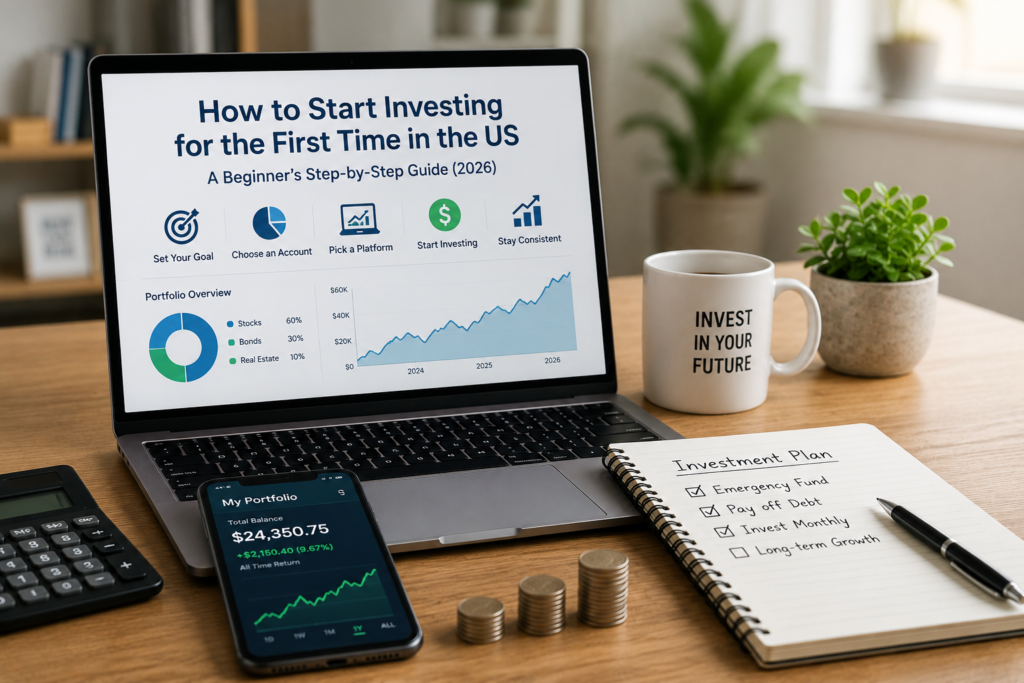
There’s a strange kind of anxiety that comes with opening your first investment account. You know you’re supposed to be doing it. Everyone from your coworkers to random people on the internet keeps talking about “putting your money to work.” But somewhere between opening an app and actually clicking “buy,” most first-time investors freeze up.
If that’s where you are right now, you’re not alone — and more importantly, you’re not doing anything wrong. Investing feels complicated because the industry has spent decades making it sound complicated. In reality, once you understand a handful of core ideas, getting started takes less time than setting up a new phone.
This guide walks you through exactly how to invest for the first time in the US — from understanding the basics to opening your account and making your first move — without the jargon-heavy explanations that usually make people give up halfway through.
Why So Many People Delay Investing
Before getting into the “how,” it’s worth talking about the “why not yet.” Most people who put off investing aren’t lazy or uninterested — they’re stuck on one of a few common concerns.
Some worry they don’t have enough money to start. Others assume investing requires deep financial knowledge they simply don’t have. And a good number of people are just afraid of losing money they worked hard to earn.
Here’s the reassuring part: none of these concerns should actually stop you. You can start investing with as little as a few dollars. You don’t need a finance degree — you need a basic understanding and a willingness to learn as you go. And while risk is real, the biggest risk for most beginners isn’t losing money in the market. It’s never starting at all and losing years of potential growth instead.
What Investing Actually Means
At its core, investing means putting your money into something with the expectation that it will grow in value over time. Instead of letting your cash sit in a savings account earning almost nothing, you use it to buy small pieces of companies (stocks), pools of investments (funds), or other assets that historically increase in value over the long run.
The reason this matters so much is compounding. When your investments earn returns, those returns can generate their own returns. Over years and decades, this snowball effect is what turns modest, consistent contributions into meaningful wealth. It’s not about picking the perfect stock — it’s about giving your money time to grow.
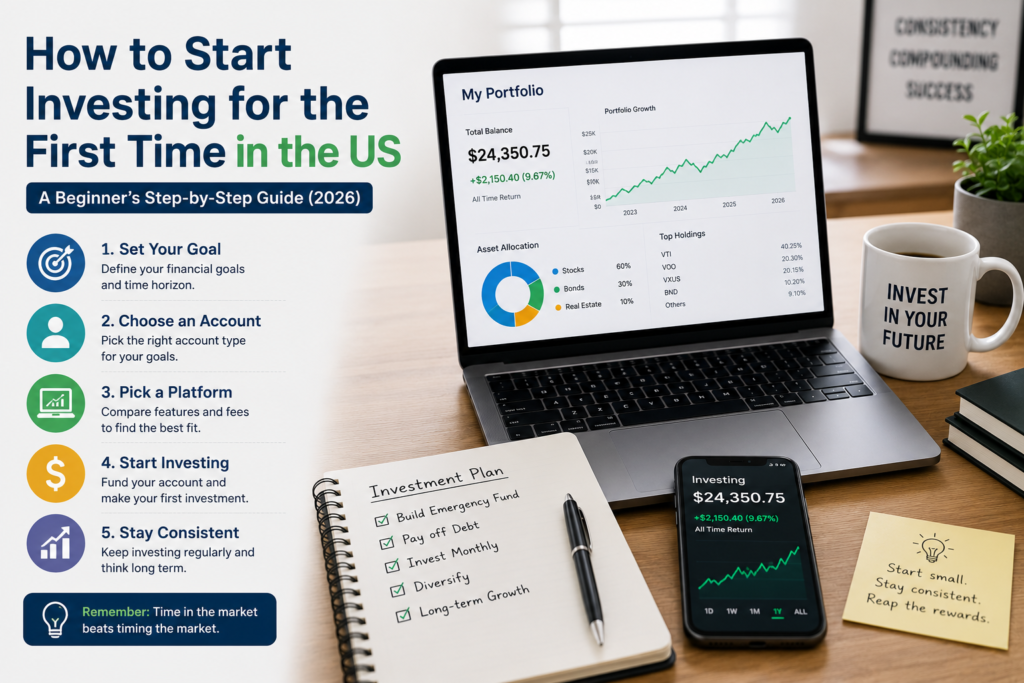
Step 1: Get Clear on Your Goal
Before opening any account, ask yourself a simple question: what am I investing for?
Your answer changes everything else that follows. If you’re investing for retirement decades away, you have more room to take on risk because you have time to recover from market dips. If you’re saving for a house down payment in two years, you’ll want a more conservative approach, since you can’t afford a bad year right before you need the money.
Common first-time investing goals include:
- Long-term retirement savings
- Building general wealth over time
- Saving for a mid-term goal like a home or a wedding
- Simply learning how investing works with a small amount of money
There’s no wrong answer here. The point is to know your “why” so the rest of your decisions actually make sense.
Step 2: Understand the Difference Between Account Types
This is where a lot of beginners get confused, so let’s simplify it.
A brokerage account is a general investment account. There’s no special tax treatment, but there’s also no restriction on when you can withdraw your money. It’s flexible and works well for goals outside of retirement.
A retirement account, like a Traditional IRA or Roth IRA, comes with tax advantages designed to encourage long-term saving. With a Roth IRA, you contribute money you’ve already paid taxes on, and your investments grow completely tax-free — meaning withdrawals in retirement aren’t taxed either. A Traditional IRA works the other way around: you may get a tax break now, but you’ll pay taxes when you withdraw the money later.
If your goal is retirement and you’re eligible, a Roth IRA is often one of the most beginner-friendly places to start, largely because of how simple the tax benefit is to understand.
If you already have an employer-sponsored plan like a 401(k), especially one with a company match, that’s usually worth prioritizing first — a match is essentially free money added on top of what you invest.
Step 3: Decide How Much You Can Actually Invest
You do not need thousands of dollars to begin. Thanks to fractional shares, many platforms now let you invest with as little as $5 or $10.
That said, before you invest anything, make sure you have a small emergency cushion set aside — even a few hundred dollars can prevent you from having to sell investments at a bad time just because an unexpected expense came up.
A simple, low-pressure approach many first-time investors use is starting with a fixed amount they won’t miss, such as $50 or $100 a month, and increasing it gradually as their income grows or their comfort level increases. Consistency matters far more than the size of your first contribution.
Step 4: Choose an Investment Platform
Once you know your goal, account type, and starting amount, the next step is choosing where to actually invest. In the US, there’s no shortage of options, and the right one depends on what you value most.
If you want a simple, mobile-first experience with an easy learning curve, beginner-focused apps are designed exactly for that. If you’d rather have your portfolio managed automatically without picking individual investments yourself, a robo-advisor style platform handles that for you based on your goals and risk tolerance. And if you want more control along with in-depth research tools, larger full-service brokerages tend to offer the most resources.
Whichever type you lean toward, pay attention to a few key factors before signing up:
- Fees — many platforms now offer $0 commission trading, but advisory fees and fund expense ratios still vary
- Account minimums — most modern platforms have none
- Available investment types — stocks, ETFs, mutual funds, fractional shares
- Ease of use — especially important for your very first account
- Customer support and educational resources
Don’t overthink this decision. Most reputable, well-known platforms are safe, regulated, and perfectly capable of supporting a beginner. You can always add a second account later if your needs change.

Step 5: Choose Your First Investments
This is usually the part that intimidates people the most, but it doesn’t have to be complicated.
For most first-time investors, the smartest starting point isn’t picking individual stocks — it’s investing in a diversified fund, such as an index fund or ETF that tracks a broad market index. These funds spread your money across hundreds or even thousands of companies at once, which naturally reduces the risk of any single company’s bad year wrecking your entire investment.
A total US stock market fund or an S&P 500 index fund is a common starting point precisely because it’s simple, low-cost, and historically has grown steadily over long periods of time. You’re not trying to predict the next big winner. You’re betting on the overall growth of the economy over decades — a far more reliable strategy for a beginner than stock-picking.
Once you’re more comfortable and have learned more about how markets work, you can always explore individual stocks, sector-specific funds, or other assets. But there’s nothing wrong with keeping things simple for as long as you want.
Step 6: Open Your Account and Make Your First Contribution
The actual sign-up process on most modern platforms takes about ten to fifteen minutes. You’ll typically need:
- Your Social Security number
- A government-issued ID
- Basic employment information
- Your bank account details to fund the account
After your account is approved and funded, you’ll place your first order — selecting the investment, entering the dollar amount or number of shares, and confirming the purchase. That’s genuinely it. There’s no ceremony required. You’ve officially become an investor.
Step 7: Set Up Automatic, Consistent Investing
One of the most underrated habits in investing is automation. Instead of relying on willpower to remember to invest every month, most platforms let you set up recurring automatic contributions — say, $100 every payday.
This approach is often called dollar-cost averaging, and it removes a lot of the emotional decision-making from investing. You’re not trying to time the market or guess whether now is a “good” time to buy. You’re simply investing consistently, which smooths out the ups and downs over time and builds the habit into your routine rather than treating it as an occasional decision.
Common Mistakes First-Time Investors Should Avoid
A few patterns tend to trip up beginners more than anything else.
Checking your portfolio every single day is one of them. Markets move up and down constantly, and watching those swings daily tends to trigger emotional decisions — panic-selling during a dip being the most damaging one.
Trying to time the market is another common mistake. Waiting for the “perfect moment” to invest usually just means money sits uninvested and misses out on growth. Time in the market consistently outperforms trying to time the market.
Investing money you’ll need soon is also risky. If you might need the cash within the next couple of years, it generally doesn’t belong in the stock market, where short-term swings are unpredictable.
Finally, many beginners underestimate how much fees can eat into long-term returns. A seemingly small annual fee difference can add up to a significant amount over 20 or 30 years, so it’s worth paying attention to costs from the start.
How Much Should You Expect to Earn?
It’s tempting to want a precise number here, but honest investing advice avoids exact promises. Historically, the US stock market has delivered average annual returns in the range of 7-10% before inflation over long periods, though any individual year can vary significantly — including years with losses.
The key word is “long-term.” Short-term results are unpredictable and sometimes discouraging. Long-term results, especially with consistent contributions, have historically rewarded patient investors far more than those trying to chase quick gains.
How to Track Your Progress Without Obsessing Over It
Once your account is open and your first contribution is in, it’s natural to want to check on things. There’s nothing wrong with that in moderation — the problem starts when checking becomes a daily habit that fuels anxiety instead of confidence.
A healthier approach is to set a fixed schedule for reviewing your investments, such as once a month or once a quarter. During these check-ins, look at the bigger picture rather than the day-to-day noise: Are you still contributing consistently? Has your goal or timeline changed? Does your investment mix still match your comfort with risk?
This kind of periodic review keeps you informed without letting short-term market movement dictate your emotions. Many platforms also offer simple dashboards or apps that summarize your account in plain language, which can make this process even less intimidating for someone just starting out.
When It Might Make Sense to Get Professional Guidance
Self-directed investing works well for most beginners, especially with today’s low-cost, user-friendly platforms. But there are situations where a conversation with a financial advisor can be worth the cost — for example, if your financial picture involves multiple goals at once, a business you own, significant debt alongside investing goals, or simply a level of anxiety that’s keeping you from taking action on your own.
Some investment platforms offer access to advisors or planning tools built into the app itself, which can be a lower-cost middle ground between fully DIY investing and hiring a private advisor. There’s no shame in wanting a second opinion, especially in the beginning. The goal is progress, not perfection — however you get there.
A Realistic Example of Getting Started
Imagine someone opens a Roth IRA with $200 and sets up an automatic monthly contribution of $150 into a diversified index fund. In the first few months, the account balance moves up and down slightly, and it might not feel like much is happening.
But five years in, that consistency has turned into a meaningful habit and a growing balance. Ten years in, the account has weathered a few market downturns and recovered each time, because the money was never withdrawn during the rough patches. Twenty or thirty years in, thanks to consistent contributions and the power of compounding, that same habit has quietly become one of the most impactful financial decisions of their life.
Nothing about this example requires special knowledge, timing luck, or a large starting balance. It requires starting, staying consistent, and giving the process enough time to work.
Frequently Asked Questions
Do I need a lot of money to start investing in the US? No. Many platforms allow you to start with just a few dollars thanks to fractional shares, and there’s no rule requiring a large initial deposit.
Is investing risky for beginners? All investing carries some risk, including the possibility of losing money. However, diversified, long-term investing in broad market funds is generally considered less risky than picking individual stocks or trying to trade actively.
What’s the difference between a brokerage account and a retirement account? A brokerage account offers flexibility with no withdrawal restrictions, while retirement accounts like IRAs offer tax advantages in exchange for rules around when you can access the money without penalties.
Should I pick individual stocks as a beginner? Most financial guidance suggests starting with diversified index funds or ETFs rather than individual stocks, since they spread risk across many companies instead of relying on the performance of just one.
How soon can I see returns? Investing isn’t designed for quick returns. Meaningful growth typically happens over years, not weeks or months, which is why starting early — even with a small amount — matters so much.
Final Thoughts
Investing for the first time can feel like standing at the edge of something much bigger than it actually is. In reality, it comes down to a few manageable steps: understanding your goal, choosing the right type of account, picking a platform that fits your needs, starting with an amount you’re comfortable with, and staying consistent over time.
You don’t need to have it all figured out before you begin. Most successful long-term investors didn’t start as experts — they started as beginners who simply took the first step and kept learning along the way. The most important investment decision you’ll ever make isn’t which stock to buy. It’s deciding to start.