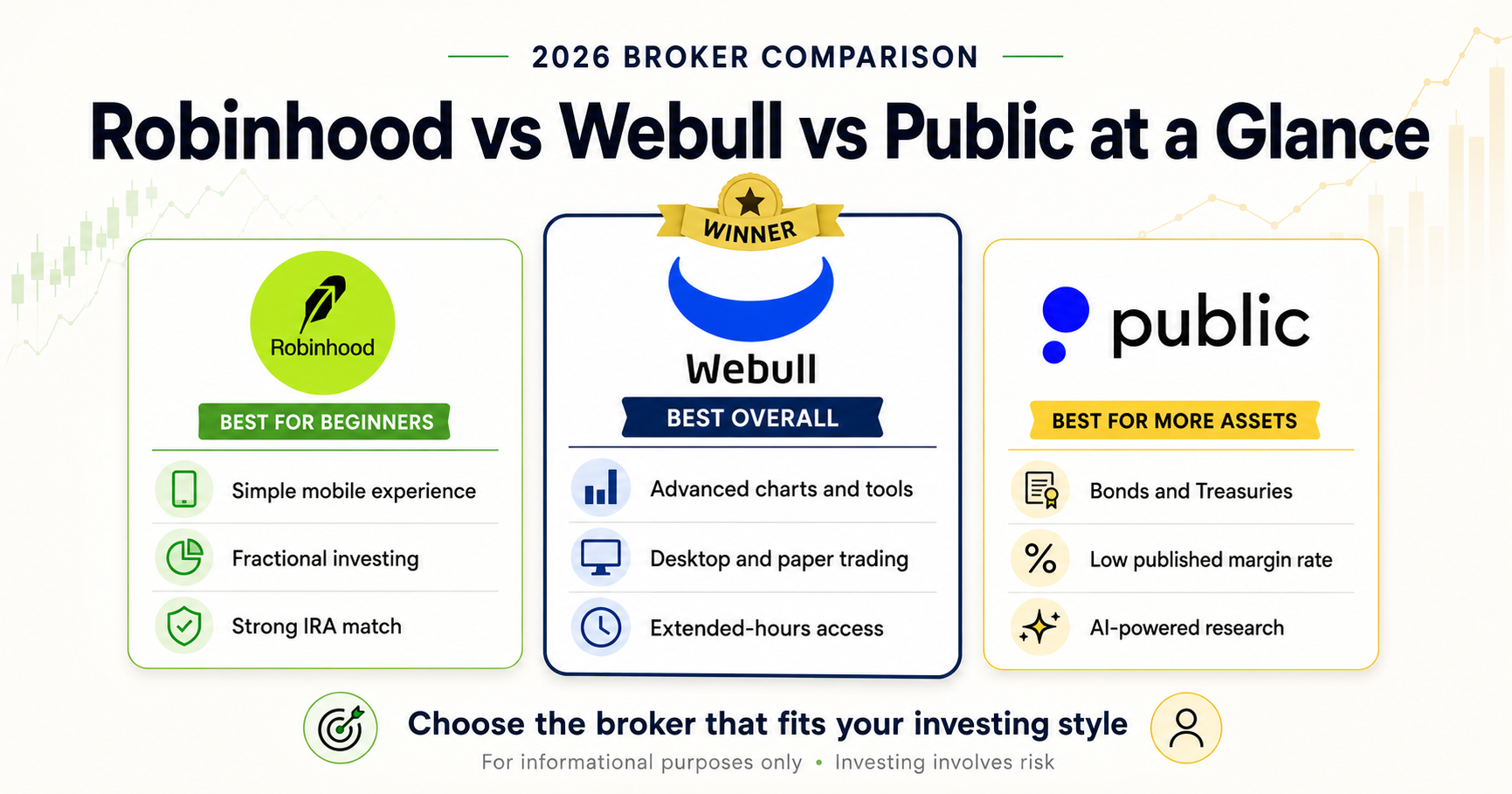
Robinhood, Webull, and Public all advertise commission-free investing, but they are no longer interchangeable apps. Robinhood emphasizes simplicity and an expanding financial ecosystem. Webull provides the deepest trading platform and paper-trading experience. Public combines conventional brokerage services with bonds, Treasuries, low margin rates, and a growing collection of AI tools.
The short answer: Webull is the best overall choice in 2026 for investors who want a powerful free platform that they can grow into. Robinhood is better for beginners who value simplicity, automatic investing, and a clean mobile experience. Public is the best specialist choice for investors who want direct access to bonds and Treasuries, competitive margin pricing, or AI-assisted research. The right winner therefore depends more on how you invest than on which app has the longest feature list.
This comparison applies to U.S. brokerage offerings and uses official pricing and product information available on July 18, 2026. Promotions, interest rates, and match programs can change, so verify the current terms before opening or funding an account.
Robinhood vs Webull vs Public at a Glance
| Category | Robinhood | Webull | Public |
| Best for | Beginners and simple mobile investing | Active traders and technical analysis | Bonds, low margin rates, and AI research |
| U.S. stocks and ETFs | $0 commission | $0 commission | $0 during regular hours |
| Stock and ETF options | $0 commission; pass-through fees apply | $0 commission; regulatory/exchange fees apply | $0 commission; regulatory fees apply; optional rebates |
| Fractional shares | Yes, from $1 on eligible securities | Yes, from $1 on eligible securities | Yes, on eligible securities |
| Extended trading | Select securities available 24/5 | Eligible securities available 24/5 | 4 a.m.–8 p.m. ET; non-Premium fee may apply |
| Paper trading | Limited compared with Webull | Yes | Not a core platform feature |
| Retirement accounts | Traditional and Roth IRAs; 1% base or 3% Gold contribution match | Traditional, Roth, and rollover IRAs; promotional or Premium matches | Traditional and Roth IRAs; 1% contribution match |
| Notable investments | Stocks, ETFs, options, crypto, futures, event contracts | Stocks, ETFs, options, crypto, futures, fixed income | Stocks, ETFs, options, crypto, bonds, Treasuries, direct indexing |
| Paid tier | Gold: $5 monthly or $50 annually | Premium: $3.99 monthly or $40 annually | Premium: $10 monthly or $96 annually; waived above qualifying balance |
| Overall verdict | Best for ease of use | Best overall | Best for multi-asset investing |
“Commission-free” does not mean every transaction is free. All three can pass through regulatory or exchange fees. Certain products, subscriptions, transfers, routing choices, bond trades, margin loans, or extended-hours orders may also cost money.
Our Verdict: Webull Wins Overall, but Robinhood Is Easier
Webull takes the overall crown because its free tier includes a mature desktop platform, customizable charts, technical indicators, paper trading, and multi-platform access. Eligible securities can trade during premarket, after-hours, and overnight sessions, creating effectively 24-hour weekday access. Webull’s official company overview confirms these features.
Robinhood remains the better first brokerage app for many beginners. Its interface is easier to understand, fractional investing starts at $1 on eligible stocks, and recurring investments are straightforward. It has also outgrown its old “mobile only” reputation through Legend, options, futures, custodial accounts, and 24 Hour Market access. Still, Webull provides more analytical depth.
Public finishes third overall but leads for fixed income, with corporate bonds, Treasuries, bond portfolios, and a bond screener. It also offers options rebates, direct indexing, a personal API, and AI research. It is less compelling as a completely free app because some extended-hours trades and Investment Plan purchases carry non-Premium fees. See Public’s fee schedule.
Fees and Commissions
Stock and ETF Trading
- Robinhood and Webull charge no commission for online trades of U.S.-listed stocks and ETFs. Public also charges $0 for U.S.-listed stock and ETF trades placed during regular market hours. At the level of an ordinary market-hours stock purchase, there is effectively a three-way tie.
- The differences appear around the edges. Public charges non-Premium customers $2.99 for extended-session stock and ETF trades and $2.99 for OTC trades. Its automated Investment Plans can cost $0.49 to $1.99 per recurring purchase, depending on the number of symbols. Premium members pay $0 for those categories. Certain user-selected routing methods can also cost $0.003 per share.
- Webull’s official pricing page lists $0 commissions for U.S.-listed stocks, ETFs, and standard equity options, plus a $75 outgoing stock-transfer fee. Robinhood also offers commission-free stocks and ETFs, but ADR custody and regulatory charges can apply. See Robinhood’s trading-fee guide.
- Fee winner: Robinhood and Webull tie for most ordinary investors. Public can still be inexpensive, but non-Premium users need to watch recurring-plan and extended-hours charges.
Options Trading
- All three brokers advertise $0 commissions on stock and ETF options, yet their total costs are not identical. Robinhood currently collects a combined $0.04 per contract to cover options regulatory and clearing costs. Index options carry an additional Robinhood contract fee of $0.50 without Gold or $0.35 with Gold, plus applicable exchange fees.
- Webull does not charge a commission for standard U.S.-listed equity options. Certain index options cost $0.50 per contract, while oversized orders can incur an additional contract charge. Webull Premium uses volume tiers for index options and futures, which may matter to very active derivatives traders.
- Public charges $0 commission for stock and ETF options and $0.50 per index-option contract, reduced to $0.35 for Premium members. It can rebate $0.06 to $0.18 per eligible stock or ETF options contract, depending on the security, order channel, and trading volume. Regulatory and clearing fees still apply.
- Options winner: Webull for tools and strategy analysis; Public for eligible traders attracted by contract rebates; Robinhood for the simplest options workflow. Options are complex and can lose value quickly, so low fees should not be the only selection criterion.
Trading Platforms and Ease of Use
Robinhood: The Cleanest Starting Point
- Robinhood makes the basic actions—searching for an investment, reviewing a chart, entering a dollar amount, and placing an order—feel approachable. That simplicity is valuable for a new investor who wants to buy diversified ETFs or schedule recurring purchases without learning a professional trading terminal.
- Robinhood has added more capable charting and a desktop experience through Legend, but its core identity remains convenience. Its fractional-share documentation says eligible purchases and sales can start at $1.
Webull: The Strongest Free Trading Workstation
- Webull’s screeners, multi-chart layouts, technical indicators, options chains, alerts, and order controls are significantly more detailed. Desktop software is available for Windows, macOS, and Linux, alongside web and mobile access. Paper trading lets users practice without risking real money.
- That power creates a steeper learning curve. A person making one monthly ETF purchase may find the charts and data panels unnecessarily busy. For swing traders, options traders, or investors who enjoy technical research, those same panels are the main reason to choose Webull.
Public: Research-Led and Multi-Asset
- Public sits between the other two in complexity. It offers AI-generated market briefings, earnings-call summaries, a research assistant, income tracking, and Generated Assets that turn user-defined criteria into a customizable index. Public warns that AI output can be inaccurate, so investors must verify it. Public’s product page describes the tools and limitations.
- Platform winner: Webull for capability; Robinhood for simplicity; Public for AI-supported research and asset variety.
Investment Choices
- Each app now reaches beyond stocks and ETFs, but its strongest product set differs.
- Robinhood supports stocks, ETFs, fractional shares, options, crypto, futures, IPO access, event contracts, recurring investments, and retirement accounts. Crypto and futures are offered through different affiliated entities and do not receive SIPC protection.
- Webull offers stocks, ETFs, fractional shares, options, futures, crypto, OTC securities, fixed income, cash management, money-market funds, self-directed IRAs, and managed portfolios. It best suits traders moving among equities, options, and futures in one analytical interface.
- Public adds corporate bonds, Treasuries, fractional bond access, direct indexing, and AI-generated portfolios to stocks, ETFs, options, and crypto. Direct indexing starts at $1,000 and carries a management fee. Bond trades include markups or transaction fees.
- If you need a large mutual-fund marketplace, comprehensive planning, a branch, or a dedicated human adviser, compare full-service brokers too.
- Investment-choice winner: Public for bonds and portfolio customization; Webull for active-market breadth; Robinhood for an easy all-in-one consumer ecosystem.
IRAs and Long-Term Investing
- Retirement incentives have become one of the most important differences in the Robinhood vs Webull comparison.
- Robinhood offers Traditional and Roth IRAs. Customers without Gold can receive a 1% match on eligible annual contributions, while Gold members can receive 3%. Robinhood states that matched assets generally must remain in the IRA for at least five years, and customers receiving the Gold match must keep Gold for at least one year. Gold currently costs $5 monthly or $50 annually. The details are available in Robinhood’s IRA overview and can change.
- Webull offers Traditional, Roth, and rollover IRAs. Its current Premium program is especially competitive: Premium users receive an ongoing 3.5% contribution match and a limited-time 3% transfer or rollover match. Webull lists a limited-time 1% contribution match for non-subscribers. To retain qualifying Premium rewards, users generally must maintain Premium for one year and keep the contribution or transfer in the IRA for five years. Webull’s Premium benefits page provides the current requirements, and its subscription page lists Premium at $3.99 monthly or $40 annually.
- Public offers Traditional and Roth IRAs with a 1% match on eligible annual contributions. Matched funds must remain in the account for at least five years to avoid an early-removal fee. Public IRAs can include stocks, ETFs, bonds, and approved options activity, and the platform also advertises a separate crypto IRA arrangement. See Public’s IRA page for current terms.
- Compare any match with subscription costs, tax considerations, transfer restrictions, and five-year holding conditions.
- IRA winner: Webull on current match value; Robinhood for a simpler retirement experience; Public for investors who want bonds within the same platform.
Margin Rates and Cash Features
- Margin is borrowed money secured by assets in a brokerage account. It can amplify gains and losses, and the broker may liquidate positions if account equity falls below required levels.
- Public has the lowest published base rate of the three for smaller balances: its July 16, 2026 fee schedule lists 4.90% for debit balances up to $50,000, declining to 3.95% at the highest tier. Robinhood lists 5.00% up to $50,000, declining to 3.95% for balances of $50 million or more. Gold includes the first $1,000 of margin borrowing, after which interest applies. Robinhood’s margin-rate table notes that rates are variable.
- Webull’s published rates as of March 31, 2026 show 8.74% for Standard accounts across the displayed balance tiers. Premium rates start at 5.20% for balances below $25,000 and decline with larger loans. Rates can change, and the tier boundaries differ among brokers, so compare the cost using the amount you would actually borrow.
- For uninvested cash, Robinhood’s High-Yield Cash Program listed a 3.35% base APY for eligible taxable brokerage cash at the time of this update. Public advertised a 3.30% APY through its High-Yield Cash Account, with cash swept to partner banks and potentially eligible for pass-through FDIC insurance subject to program conditions. Webull also operates a cash-management program, with enhanced rates for eligible Premium cash accounts; its displayed rate can change.
- Margin winner: Public by a narrow margin at the lowest published tier. Cash winner: No permanent winner—APYs are variable and should be checked on the day you fund an account.
Safety and Account Protection
- Robinhood Financial, Webull Financial, and Public Investing are U.S. broker-dealers and members of SIPC for eligible securities accounts. SIPC protection generally covers missing cash and securities if a member brokerage fails, up to $500,000 per qualifying customer capacity, including a $250,000 cash limit. It does not reimburse ordinary market losses. SIPC explains the coverage and exclusions.
- Webull also describes excess SIPC coverage through clearing arrangements, subject to policy limits and conditions. That extra coverage does not make investments less volatile or protect a bad trade. Cryptocurrency, futures, and certain cash or third-party products can fall under different entities and protection regimes. Robinhood and Public explicitly state that crypto is not SIPC protected, and Webull states that futures accounts are outside SIPC coverage.
- Enable multi-factor authentication, use a unique password, verify transfer instructions, and never share one-time security codes.
- Safety verdict: All three provide the baseline protections expected of regulated U.S. securities brokers. Webull discloses additional excess SIPC coverage, but no broker eliminates investment risk.
Pros and Cons
Robinhood Pros
- Clean and beginner-friendly mobile experience
- $1 fractional investing on eligible securities
- Straightforward recurring investments and dividend reinvestment
- Competitive IRA match, especially with Gold
- Growing platform with Legend, crypto, futures, and 24/5 trading
Robinhood Cons
- Research and simulated trading remain less central than on Webull
- Best cash and retirement perks may require Gold
- Simple design can be limiting for advanced technical traders
Webull Pros
- Best charts, screeners, paper trading, and desktop platform of the three
- $0 commissions on U.S.-listed stocks, ETFs, and standard equity options
- Broad trading hours and strong order controls
- Premium is relatively inexpensive
- Strong current IRA contribution match for Premium users
- Webull Cons
- Interface can overwhelm first-time investors
- Standard margin rate is materially higher than Robinhood and Public’s entry tiers
- Some market data, advanced benefits, and lower rates require Premium or separate eligibility
Public Pros
- Excellent access to corporate bonds and U.S. Treasuries
- Competitive published margin rates
- Options rebates for enrolled, eligible trades
- AI research, earnings summaries, direct indexing, and a personal API
- 1% IRA contribution match without a Premium requirement
Public Cons
- Non-Premium extended-hours trades can cost $2.99
- Recurring Investment Plans may charge non-Premium users per purchase
- Premium costs more than Robinhood Gold or Webull Premium
- Specialized bond, Treasury, direct-indexing, and crypto products carry their own fees
Which Broker Should You Choose?
Choose Robinhood if you are a beginner, make simple long-term stock or ETF purchases, value a polished mobile experience, or want a straightforward IRA and consumer-finance ecosystem.
Choose Webull if you actively trade, use technical analysis, want paper trading, prefer a customizable desktop workstation, or want the strongest combination of free tools and current Premium IRA incentives.
Choose Public if fixed income is central to your strategy, you compare individual bonds and Treasuries, you want a low published margin rate, or you value AI research and programmatic investing more than simulated trading.
For most people comparing Robinhood vs Webull in 2026, the decision is simple: Robinhood is easier to begin with, but Webull offers more room to grow. Public is the alternative when your investment menu extends beyond the usual stock, ETF, crypto, and options mix.
Frequently Asked Questions
Is Robinhood or Webull better for beginners?
Robinhood is generally better for beginners because its interface and recurring-investment workflow are easier to understand. Webull is better for a beginner who specifically wants to learn charting or active trading through paper trading before risking money.
Which broker is cheapest: Robinhood, Webull, or Public
?
For a basic U.S.-listed stock or ETF trade during regular hours, all three can charge $0 commission. Robinhood and Webull are simpler “free” choices around recurring and extended-hours equity activity. Public can be cheaper for margin borrowing, while non-Premium Public users may pay for extended-hours trades or Investment Plan purchases.
Is Webull better than Robinhood for options?
Webull is better for traders who need detailed options chains, charts, simulated trading, and advanced order analysis. Robinhood provides a simpler experience. Public may appeal to eligible options traders because of its rebate program. Options approval requirements and pass-through fees apply.
Which app is best for long-term investing?
Robinhood and Webull currently offer the strongest IRA match incentives, subject to subscription and holding requirements. Public is attractive for long-term investors who want direct bonds, Treasuries, or diversified income assets. Your asset allocation and costs matter more than the app’s appearance.
Can I have accounts at all three brokers?
Yes. Some investors use one platform for long-term holdings and another for active trading. Multiple accounts create more tax forms, transfer complexity, and administration.
Are Robinhood, Webull, and Public safe?
Their eligible securities brokerage accounts receive SIPC protection within applicable limits, but SIPC does not insure against falling prices. Crypto, futures, and bank-sweep products can have different protections. Always confirm which legal entity holds each asset.
Final Verdict
Webull is the best free broker overall in this three-way 2026 comparison. It combines commission-free core trading with the strongest charts, paper trading, broad platform access, long trading hours, and a low-cost Premium tier. It is the easiest recommendation for investors who want one platform that can support both learning and more advanced trading.
Robinhood is still the better choice for pure simplicity. Its clean experience, fractional shares, recurring investments, and retirement benefits make it especially effective for first-time investors who do not need a dense analytical workstation.
Public is the best alternative for investors whose priorities include bonds, Treasuries, margin pricing, options rebates, or AI-assisted research. It can be an excellent platform, but users should read its fee schedule carefully because not every recurring, extended-hours, or specialized product is free.
Ultimately, the best broker is the one whose costs, investment choices, protections, and workflow match your plan. Start with the assets you intend to own and how often you expect to trade; then choose the app. Do not select a broker solely because of a temporary bonus